Currency Risk Explained: Why Exchange Rates Matter from Budapest to Banjul
When currencies change value, the effects can reach businesses, students, travellers, governments and ordinary households. Using Hungary and The Gambia as practical examples, we explain currency risk, why it matters in international relations and how businesses can manage it.
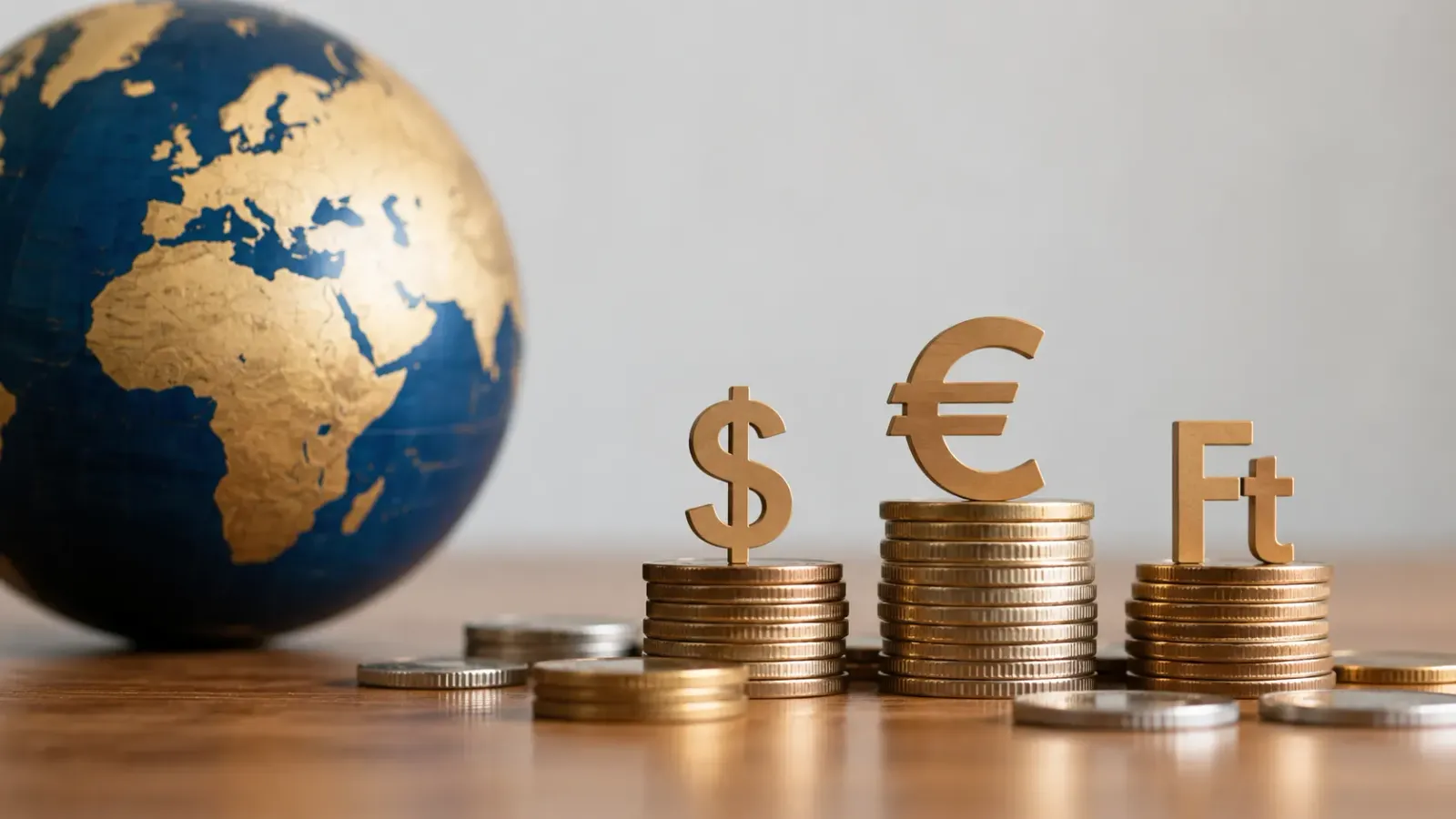
When we hear that a currency has “strengthened” or “weakened,” it can sound like something belonging to economists, central banks and financial markets.
In reality, exchange rates can affect something as ordinary as the price of an imported car in The Gambia, the amount a Gambian student needs while studying in Hungary, or the final cost faced by a Hungarian company selling equipment to a customer abroad.
This is currency risk, sometimes called foreign-exchange or FX risk.
And understanding it is increasingly important in a world where businesses, governments and individuals regularly operate across borders.
Start With the Currencies
Hungary’s national currency is the Hungarian forint (HUF).
The Gambia’s national currency is the Gambian dalasi (GMD).
Neither country currently uses the euro as its national currency.
Suppose a Gambian business wants to purchase equipment from Hungary. The Hungarian supplier may calculate its costs in forints but quote the international buyer in euros.
Suddenly, three currencies may matter:
Dalasi → Euro → Forint
The machinery itself may not change. Its factory price may not change. The shipping route may not change.
Yet the amount ultimately paid by either party can change simply because the currencies move against one another.
That uncertainty is currency risk.
A Simple Example
Imagine a Gambian company agrees to purchase Hungarian agricultural equipment for €50,000, with payment due three months later.
For illustration only, suppose €1 is worth 80 dalasi when the contract is signed.
The Gambian company therefore expects the purchase to cost:
€50,000 × D80 = D4,000,000
But payment is not due today.
Three months later, imagine the dalasi has weakened and €1 now costs D90.
The invoice is still €50,000.
But:
€50,000 × D90 = D4,500,000
The Gambian company now needs an additional D500,000 to buy the same €50,000.
Nothing happened to the equipment.
The currency moved.
That is currency risk in its simplest form.
But the Risk Works Both Ways
Currency movements do not automatically mean a loss.
Suppose instead that the dalasi strengthened from D80 to D75 against the euro before payment.
The same €50,000 invoice would then cost:
€50,000 × D75 = D3,750,000
The importer would effectively spend D250,000 less than originally anticipated.
This is why currency movements create both risk and opportunity.
The fundamental problem for businesses is uncertainty.
A company preparing a budget wants to know what something will cost. Large movements between the date a contract is signed and the date payment is made can make that difficult.
The Hungarian Business Faces Risk Too
Now look at the transaction from Budapest.
A Hungarian manufacturer has employees, electricity bills, taxes, suppliers and other operating expenses that may ultimately be denominated in forints.
If it sells internationally in euros or dollars, changes between those currencies and the forint can affect how much revenue the company ultimately receives in its domestic currency.
The Gambian importer and Hungarian exporter can therefore be exposed to different sides of the same currency movement.
This is one reason international contracts pay close attention to a deceptively simple question:
Which currency will we use?
The answer determines who carries particular exchange-rate risks.
Why This Matters for Trade Between Hungary and The Gambia
Imagine a Hungarian company interested in selling agricultural technology, medical equipment or machinery in The Gambia.
The Gambian customer may earn most of its revenue in dalasi.
The Hungarian company may incur much of its expenditure in forints.
Yet the international transaction might be priced in euros.
That creates a chain of currency exposure.
It also demonstrates why developing international trade involves much more than finding a buyer and seller.
Businesses must consider:
- the currency in which the contract is written;
- when payment will occur;
- what happens if exchange rates move substantially;
- banking and conversion costs;
- whether prices remain profitable after currency movements; and
- whether some form of protection against exchange-rate movements is appropriate.
This is part of the financial architecture behind international trade.
What Is “Hedging”?
Businesses do not always simply wait and hope that exchange rates move in their favour.
They can sometimes hedge currency risk.
Hedging essentially means taking steps to reduce exposure to an uncertain future currency movement.
One common instrument is a forward contract.
Imagine our Gambian importer knows that it must pay €50,000 in three months. Depending on the products and services available through its financial institution, it may be possible to agree in advance on an exchange rate for that future transaction.
The company sacrifices the possibility of benefiting fully from a favourable currency movement, but it gains something businesses often value greatly:
certainty.
There are other approaches, including currency options, natural hedging and matching foreign-currency income with foreign-currency expenses. These mechanisms can become sophisticated and should normally be considered with qualified financial professionals.
But the underlying principle is straightforward:
You may not be able to control the exchange rate, but you can sometimes control how exposed you are to it.
Currency Risk Is Not Only a Business Issue
Consider a Gambian student studying in Hungary.
A family in The Gambia may save money in dalasi while the student’s daily expenses in Hungary are in forints.
If the relationship between those currencies changes significantly, the amount the family needs to provide can also change.
Travellers encounter the same phenomenon.
Governments encounter it on a much larger scale when borrowing internationally, purchasing goods from abroad or servicing debt denominated in foreign currencies.
Currency therefore connects household economics, international business and state policy.
Currency and International Relations
This is where economics meets diplomacy.
Currencies are influenced by many factors: inflation, interest rates, economic growth, government finances, international investment, political uncertainty, market expectations and decisions taken by central banks.
Exchange rates can consequently influence trade competitiveness, foreign investment, government borrowing and relations between economies.
That is why currencies belong not only to economics but also to international political economy.
When diplomats discuss trade, investment and economic cooperation, somewhere beneath those conversations are questions about currencies, financing, payment systems and financial stability.
From Budapest to Banjul
As economic relationships between countries develop, understanding these basic mechanisms becomes increasingly useful.
A Hungarian entrepreneur exploring The Gambia should understand that a Gambian partner may face exchange-rate pressures very different from those experienced in Hungary.
Likewise, a Gambian business considering Hungarian products should understand that the price quoted today may not represent its final cost months later if payment is denominated in a foreign currency.
Neither side needs to become a currency trader.
But both benefit from understanding the risk.
That is one of the realities of international commerce: sometimes the greatest change in the price of a product occurs without anything happening to the product at all.
The exchange rate simply moved.
Educational note: The exchange rates and transaction above are hypothetical and are used solely to explain currency risk. They do not represent current market exchange rates. This article is provided for general educational information and does not constitute financial or investment advice.