The Gambia's Historic Presidential Nominations: Democracy, Political Participation and the Road to December 2026
As The Gambia prepares for its presidential election on 5 December 2026, a historic nomination exercise has attracted unprecedented political interest. The process highlights democratic participation, electoral transparency and the continuing evolution of the country's political institutions.
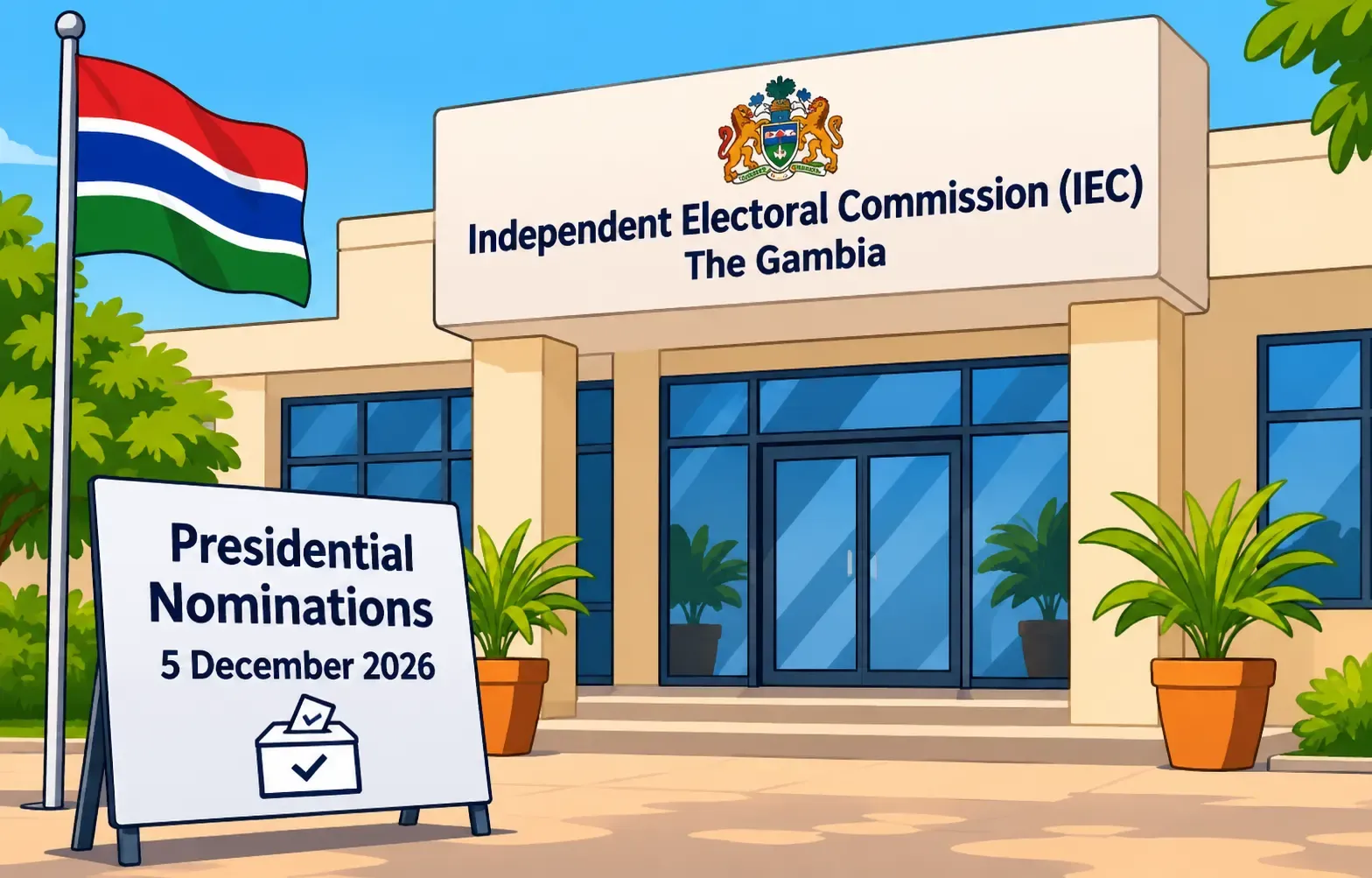
Banjul, The Gambia — 10 November 2026 — The Gambia is witnessing one of its most closely watched presidential nomination exercises in recent history, as political parties, coalitions and independent aspirants seek to qualify for the presidential election scheduled for 5 December 2026.
The nomination process, organised by the Independent Electoral Commission (IEC), began on 3 November and is scheduled to conclude on 14 November. It represents an important stage in the country’s democratic development, bringing renewed attention to political participation, electoral accountability and the role of independent institutions.
With a large number of prospective candidates expressing interest, the exercise reflects an increasingly diverse political environment in which established parties, emerging political movements and independent figures are seeking to present their visions for The Gambia’s future.
An Unusually Crowded Presidential Field
According to the IEC, 27 prospective candidates had collected nomination forms by the time the official nomination schedule was published.
The level of interest is notable in a country where presidential contests have historically featured a much smaller final field. In the 2021 presidential election, six candidates were approved to contest the presidency.
The 2026 exercise has attracted political figures representing different generations, professional backgrounds and political perspectives.
Among the prominent aspirants are incumbent President Adama Barrow of the National People’s Party (NPP), United Democratic Party (UDP) leader Ousainou Darboe, and Talib Ahmed Bensouda of UNITE.
Former Vice President Dr Isatou Touray is also among those who have submitted nomination documents, alongside other party representatives and independent aspirants.
The presence of established political leaders alongside newer contenders has generated significant public interest in the direction of the country’s democracy.
However, collecting nomination forms or submitting documents does not automatically qualify an aspirant to appear on the ballot.
The Nomination Process: How Candidates Qualify
The IEC is responsible for examining nomination documents and determining whether prospective candidates satisfy the legal requirements for contesting the presidency.
Under the electoral framework outlined by the Commission, applicants must satisfy citizenship, age and educational requirements.
They must also obtain the signatures of at least 5,000 registered voters, including a minimum of 200 supporters from each administrative area, and pay a nomination deposit of D1 million.
Additional documentation includes declarations of assets, tax clearance certificates and information identifying the candidate’s electoral symbol and manifesto.
These requirements are intended to establish a formal and consistent process for assessing eligibility.
The Commission’s responsibility extends beyond receiving applications. It must verify supporting documentation, identify deficiencies and communicate decisions in accordance with the applicable electoral framework.
Latest Developments in the Nomination Exercise
At a briefing reported on 10 November, IEC Chairman Joseph Colley disclosed that 12 aspirants had submitted nomination documents by the end of the sixth day of the exercise, while six prospective contenders had withdrawn.
Several submissions remained subject to further verification or correction, including outstanding signatures, deposits and supporting documents.
The IEC reported that Talib Ahmed Bensouda’s submission had satisfied the documentation and signature requirements examined at that stage, without the need for additional submissions.
Other aspirants were given opportunities to address outstanding requirements before the nomination period closes.
Meanwhile, Ousainou Darboe submitted his nomination papers on 9 November, accompanied by supporters of the UDP.
President Adama Barrow was scheduled to submit his documents on 10 November.
The final number of candidates will only become clear after the IEC completes its assessment and announces the approved list.
A Defining Period in The Gambia’s Democratic Journey
The significance of the 2026 election extends beyond the number of presidential aspirants.
The Gambia’s political history includes independence in 1965, the transition to republican status in 1970, the military takeover of 1994 and the democratic transition following the 2016 presidential election.
That transition, which resulted in the departure of former President Yahya Jammeh and the assumption of office by President Adama Barrow in January 2017, marked an important turning point in the country’s political history.
The December 2026 election will therefore take place against a background of continued discussions about constitutional governance, institutional reform, political accountability and the country’s democratic future.
For many citizens, the election also presents an opportunity to evaluate competing proposals on employment, education, healthcare, infrastructure, economic development and public administration.
Political Competition and National Unity
As political activities intensify, maintaining peaceful engagement and respect for democratic institutions will be essential.
Competitive elections naturally produce differences in political opinion. However, the credibility of the electoral process depends on the ability of political actors, institutions and citizens to participate within a framework of mutual respect and the rule of law.
Political parties and independent candidates have an important responsibility to communicate their programmes clearly, while citizens have the opportunity to examine proposals and make informed electoral choices.
The media, civil society organisations and election observers also contribute to transparency through public education, scrutiny and independent monitoring.
Looking Ahead to 5 December
Following the nomination exercise, the official presidential campaign period is scheduled to run from 16 November to 3 December 2026.
The IEC has designated 4 December as a campaign-free day, ahead of polling on Saturday, 5 December.
As the country approaches election day, attention will increasingly shift from candidate eligibility to policy proposals, public debates and the priorities of Gambian voters.
The large number of initial aspirants has made the nomination exercise particularly noteworthy. Nevertheless, the lasting significance of the 2026 presidential election will be determined not simply by the size of the field, but by the transparency of the process, the peaceful conduct of the campaign and public confidence in the outcome.
For The Gambia, the 2026 presidential nominations represent more than an administrative electoral exercise. They are another chapter in the country’s continuing democratic journey, reflecting the importance of political participation, institutional responsibility and the collective commitment to a peaceful national future.